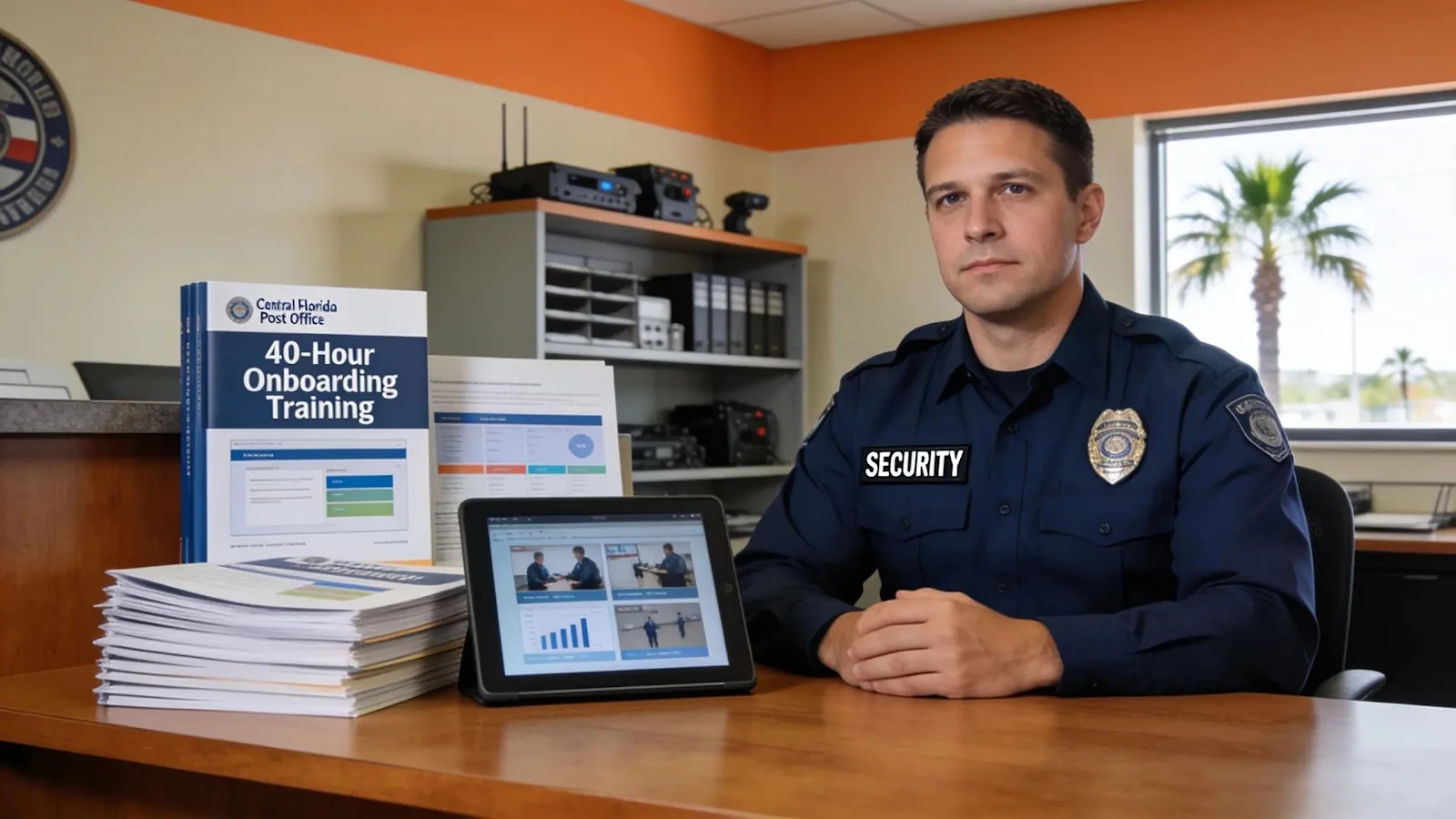
Our 40-hour onboarding program prepares every security officer before they step onto a client site. New guards complete structured instruction covering post procedures, emergency response, and professional conduct. Strict background checks precede training. Rising Force Security holds officers to rigorous standards because unqualified personnel create liability. And our clients across Central Florida deserve better.
Key Takeaways
- Florida law mandates completion of a 40-hour Class D course and state licensing before security officers begin work.
- The 40-hour onboarding program covers criminal law, patrol fundamentals, terrorist indicators, and safety planning.
- Rising Force Security employs 501 professionals supported by structured onboarding to maintain operational standards.
- Florida's Department of Agriculture and Consumer Services (FDACS) oversees all mandated security training and approves qualifying guard schools.
What prerequisites must a security officer candidate meet?
Every security officer candidate must satisfy Florida's state licensing requirements and pass a rigorous internal vetting process before deployment. Rising Force Security holds license number B3000012 and enforces standards that meet. And in many cases exceed — what state law mandates.
Orlando security guard requirements begin with Florida's mandatory security officer training Orlando framework. Candidates must complete the state-required 40-hour Class D course before receiving an unarmed security officer license. No candidate joins our team without that credential in hand.
What does the 40-hour Class D course cover?
Florida's Class D licensing course delivers 40 hours of structured instruction covering legal authority, patrol procedures, emergency response, and professional conduct. Completion of this course is a non-negotiable prerequisite for any unarmed officer we deploy across Central Florida.
How does Rising Force Security vet candidates beyond state minimums?
Our guard onboarding program adds a strict background check layer on top of state requirements. Every candidate undergoes thorough screening designed to confirm integrity, reliability, and fitness for duty — before a single shift begins. Officers who cannot clear this process are not deployed, period.
Prerequisites at a glance:
- Complete the state-mandated 40-hour Class D training course
- Pass Rising Force Security's strict internal background check
- Confirm active Florida security officer licensure
- Demonstrate readiness to prevent, de-escalate, and respond to security threats
Meeting these standards is not optional. Clients depend on it.
How does the 40-hour training curriculum work?
Florida's mandatory security officer training for Orlando candidates lasts 40 hours. Follows a structured sequence of live instruction, attendance verification. A final course assessment. Skipping or shortcutting any phase disqualifies a candidate from licensure. A costly setback that delays deployment and leaves client sites exposed.
Prerequisites before training begins:
- Confirm eligibility under Florida's Orlando security guard requirements (age, background check, valid ID)
- Secure enrollment in a state-approved, compliant training program
- Arrange reliable access to live instruction sessions for the full 40-hour duration
The curriculum unfolds in this order:
- Complete live instruction hours. Attend every scheduled session. Attendance is formally verified, so missed hours cannot be made up informally.
- Cover core security disciplines. Instruction addresses maintaining order, controlling access, and keeping environments safe without unnecessary escalation — the operational foundation every officer carries into the field.
- Study advanced protective topics. Coursework extends into criminal and civil law, information gathering, patrol fundamentals, security and safety planning, terrorist indicators, and basic first aid — building the situational awareness that separates a prepared officer from an unprepared one.
- Pass the final course assessment. A formal evaluation confirms competency before any certificate is issued.
What topics are covered in the 40-hour security guard course?
The curriculum spans both foundational and advanced subject matter. Officers study access control, order maintenance. De-escalation alongside more specialized areas such as civil and criminal law, weapons of mass destruction awareness, and emergency first aid.
How does Rising Force Security use this training in its guard onboarding program?
Rising Force Security builds the state curriculum into a broader onboarding framework. Our officers enter the field already trained to maintain safe, welcoming environments. And accountable to the professional standards our clients depend on.
What does site-specific onboarding training cover?
Guard onboarding program content at Rising Force Security spans access control, patrol procedures, de-escalation techniques, and emergency response — all calibrated to the specific property an officer is assigned to protect. Skipping structured onboarding leaves critical gaps in coverage that expose clients to theft, unauthorized access, and liability.
Our onboarding process follows a deliberate sequence. Prerequisites: officers must hold a valid Florida security license before site-specific training begins.
- Review the post orders. Study the written directives for the assigned site, including emergency contacts, restricted zones, and escalation protocols.
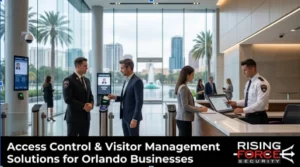
- Master access control procedures. Learn to monitor every entry point, verify credentials against the approved access list, and manage visitor access so only authorized personnel enter the property.
- Execute patrol routes. Conduct both foot and vehicle patrols along designated paths to deter theft, vandalism, and trespassing while maintaining a visible security presence.
- Practice de-escalation and rapid response. Armed officers train specifically to respond effectively and tactically in high-risk scenarios, prioritizing calm resolution before force.
- Complete a supervised walkthrough. Shadow an experienced officer for at least one full shift to apply each procedure in a live environment before assuming independent post duties.
Why does access control training matter on every post?
Access control is the first line of defense on any property. Rising Force Security trains officers to verify credentials and manage visitor access consistently. A single lapse at an entry point can compromise an entire facility.
How does patrol training reduce on-site incidents?
Routine patrols create visible deterrence that discourages criminal activity before incidents occur. Our security officer training Orlando operations emphasize proactive patrol patterns rather than reactive responses, reflecting our commitment to long-term partnerships. Orlando security guard requirements compliance. Not simply filling posts.
How does technology integration fit into guard onboarding?
Technology integration is a foundational component of how Rising Force Security builds accountable, high-performing officers from day one. Without structured exposure to operational tools during onboarding, guards enter the field unprepared. And gaps in oversight cost clients the reliability they depend on.
Our guard onboarding program introduces officers to the specific platforms and systems they will use on every shift. We do not treat technology as an afterthought. Every officer learns our operational infrastructure before stepping onto a post.
What technology do guards learn during onboarding?
Rising Force Security equips officers with hands-on familiarity with GPS guard tour systems and real-time digital reporting tools. These systems create a verifiable record of every patrol, every checkpoint, and every incident. Giving clients transparent, documented accountability around the clock. Our 24/7 supervision model depends on officers who can operate these tools correctly from their first shift.
How does surveillance technology connect to guard responsibilities?
Modern security deployments increasingly pair officers with integrated surveillance infrastructure. Property setups across Central Florida commonly include HD cameras, motion detection, on-device or cloud analytics, and remote viewing tools. Guards trained during security officer training Orlando programs must understand how to interpret alerts from these systems and coordinate their patrol response accordingly. An officer who cannot read a motion-triggered alert or verify a camera feed is a liability — not an asset.
Prerequisites before technology training begins:
- Complete all licensing steps required under Orlando security guard requirements, including background screening and state-mandated coursework.
- Confirm assignment to a specific post type so technology training matches the actual equipment on site.
- Review the client's site security plan with a supervising officer.
- Complete hands-on GPS tour system orientation with a field supervisor present.
- Demonstrate accurate digital incident reporting before the first solo shift.
What common onboarding mistakes should programs avoid?
Weak onboarding programs share three recurring failure points: skipping pre-deployment vetting, bypassing state-mandated training. Applying inconsistent standards across a growing workforce. Each gap creates measurable liability — for the client, the officer, and the security firm.
Does skipping background checks before deployment put clients at risk?
Deploying an officer without rigorous vetting is one of the most serious errors a security program makes. At Rising Force Security, strict background checks are completed before any officer reaches a post — armed or unarmed. Vetting confirms that officers are equipped not only to respond to incidents. To prevent and de-escalate them before situations escalate.
What happens when officers miss the required pre-assignment training?
Florida law requires completion of a 40-hour pre-assignment course before an officer receives a Class D license. Skipping or shortcutting this requirement leaves officers unlicensed and the program non-compliant with state standards. That is not a paperwork problem. It is a legal exposure that undermines the protection clients depend on. Contact us to discuss compliance, or request a quote to see how a properly credentialed team is structured.
To build a compliant guard onboarding program, avoid these critical errors in order:
- Verify credentials first. Confirm every candidate's background check is complete before scheduling any field assignment.
- Complete the full 40-hour training. Do not place officers on post until state licensing requirements are satisfied.
- Standardize the process across every hire. With a workforce the size of Rising Force Security's, consistent procedures are the only way to maintain uniform quality.
Inconsistency is the silent failure. One undertrained officer undermines the credibility of an entire program.
A rigorous 40-hour onboarding program is not simply a regulatory requirement. It is the foundation upon which dependable, professional security service is built. Rising Force Security's commitment to structured, comprehensive officer training reflects a broader standard of accountability that clients throughout Central Florida rely on every day. When you engage a security partner that invests seriously in its personnel from day one, you engage one that takes the protection of your property and people with equal seriousness.
Conclusion
A structured 40-hour security officer training program is the foundation every compliant, field-ready officer is built on. Rising Force Security's onboarding framework covers the full arc — from Florida's mandatory Class D curriculum and strict background vetting, through site-specific post orders, access control, patrol execution, and hands-on technology integration — so officers arrive prepared, accountable, and licensed at every post — whether in Orlando, Melbourne, Miami, or anywhere across Central Florida. Skipping any phase, whether pre-assignment vetting, state-mandated coursework, or technology orientation, creates the liability gaps that undermine client trust and regulatory standing. If your organization is evaluating a security partner whose guard onboarding program matches these standards, Rising Force Security is ready to walk you through our process.
Professionally Trained Security Officers
Put a Prepared, Accountable Security Team on Your Property
Request a tailored security program backed by licensed officers, structured onboarding, GPS-verified patrols, 24/7 supervision, and real-time reporting.
Licensed & Insured · Customized Security Programs · Responsive 24/7 Support